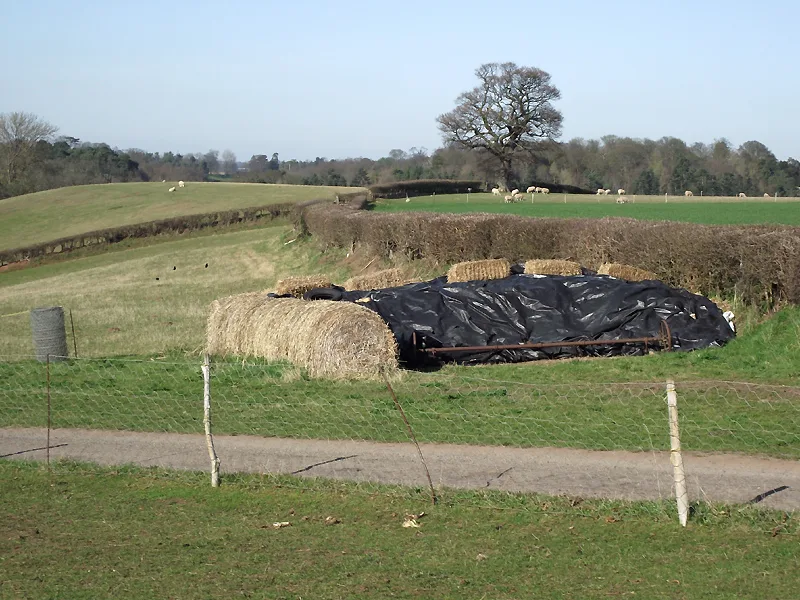

Three appliances and a water carrier went to 100 tonnes of burning hay bales near Bridgnorth on Thursday. Shropshire has logged 36 field fires this summer.
About 100 tonnes of hay bales caught fire at Barnsley on Thursday evening. Barnsley is a hamlet roughly two and a half miles east of Bridgnorth town centre, on OpenStreetMap’s position for it.
Shropshire Fire and Rescue Service logged the call at 19:53 on 17 September. Its own record of the incident, number 152839, gives the location as Barnsley, Bridgnorth, and the type as a fire in the open.
The record says: “Approximately 100 tonnes of hay bales alight, crews extinguished using 2 Hose reel jets and farm machinery to turn over hay.”
What the log records attending:
- three appliances, from Bridgnorth and Telford Central
- a water carrier
- operations officers
- breathing apparatus and hose reel jets
The service has not given a cause. Its record does not say how the fire started, and no follow-up entry for Barnsley had appeared on the log by lunchtime on Friday. Nobody is recorded as hurt, and no other agency is listed as attending.
The biggest bale fire in this year’s log
We read every incident Shropshire Fire has published in its three farm categories since 1 July: barn fires, field and stubble fires, and fires in standing corn and crops. There are 42 of them.
No other record in that set puts a weight anywhere near 100 tonnes. The next two largest quantities of hay or straw given a tonnage are:
- 30 tonnes of straw in a barn at Painsbrook Lane, Hadnall, on 2 September
- 20 tonnes of hay on a farm vehicle at Dinthill, Ford, on 22 July, alongside about 100m by 100m of stubble
The busiest single farm fire of the summer was on Bridgnorth’s own ground. On 6 July crews went to Kings Nordley, where the log records 40 hectares of crops, shrubbery and hedgerow alight. Six appliances attended, the incident was sectorised, and Hereford and Worcester and West Midlands fire services both assisted.
Field fires are running at seven times last summer
The number that stands out is not the tonnage. It is how often crews are being called out to fields at all.
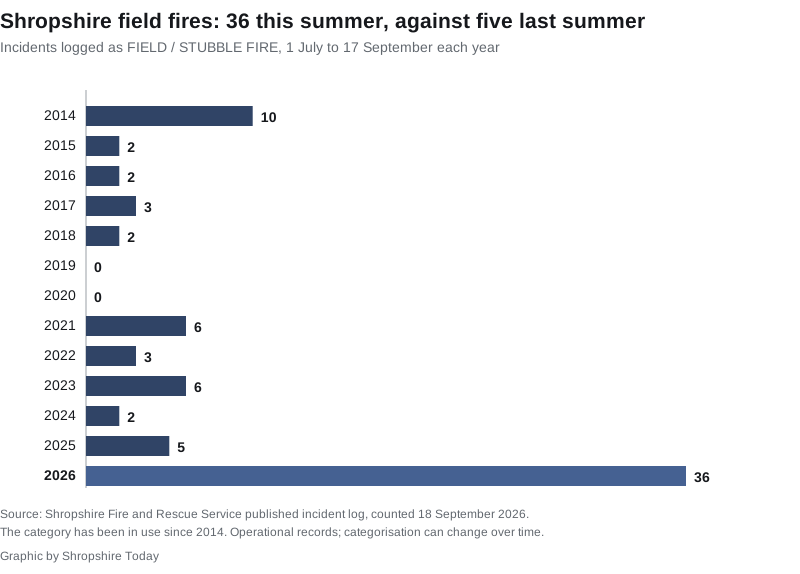
Taking the same window every year, 1 July to 17 September, Shropshire Fire’s log records 36 field and stubble fires this summer. Last summer it recorded five. The highest in any previous summer since the category came into use in 2014 was ten.
| 1 July to 17 September | Field and stubble fires |
|---|---|
| 2014 | 10 |
| 2015 | 2 |
| 2016 | 2 |
| 2017 | 3 |
| 2018 | 2 |
| 2019 | 0 |
| 2020 | 0 |
| 2021 | 6 |
| 2022 | 3 |
| 2023 | 6 |
| 2024 | 2 |
| 2025 | 5 |
| 2026 | 36 |
Fires in the open, the broader category the Barnsley fire sits in, are up too: 464 this summer against 272 last summer and 127 in the summer of 2024.
The whole summer was busier. The log holds 1,224 incidents of every kind between 1 July and 17 September this year, against 958 last year, a rise of 28%. Field and stubble fires rose more than seven times over the same period, so they have climbed far faster than the workload as a whole.
One caution worth stating plainly. These are the service’s own operational records, and how a crew categorises a fire can change over time. A jump of that shape can reflect recording practice as well as the weather, and the service has not published an explanation for it.
The service did describe the summer as exceptional. In a notice on 17 August thanking staff and the public after an exceptionally busy period, it said firefighters had responded to “a significant increase in incidents across the county, including more than 130 fires in the open during July alone”.
Farmers are putting a lot of these out themselves
Reading the 42 records together, one pattern repeats. The fire is often out before the first engine arrives, because the farm dealt with it.
In five of the 42, the log says the fire had already been extinguished by farmers when crews got there:
- Chadwell Lane, Newport, 24 July, where the farmer also lent crews a water sprayer
- Chorley, 31 July, where four tons of hay bales and a 50m by 20m patch of straw in a field were alight
- Bromfield Road, Bromfield, near Ludlow, 5 August, where farmers used machinery
- Mose, Quatford, near Bridgnorth, 15 August
- Stank Lane, Bishop’s Castle, 25 August
At Oreton on 24 July crews used a local farmer’s water bowser to fight a fire in about 150m by 150m of standing crop. At Barnsley on Thursday, farm machinery was used to turn the burning hay over so the jets could reach it.
Bridgnorth’s crews have had three other field fires on their ground since July: Kings Nordley on 6 July, five acres of stubble and hedgerow at Draycott, Claverley, on 25 July, and the Mose fire near Quatford in August.
What it means for you
If you farm, or you keep hay or straw in any quantity, Shropshire Fire publishes a farm fire safety leaflet with specific numbers in it. Most of it is not widely known, so it is worth setting out.
On when hay stacks catch fire, the service’s guidance says:
- hay fires generally happen within six weeks of baling
- wet hay is more likely to lead to a spontaneous combustion fire than dry hay
- above roughly 22% moisture in a barn or stack, the risk goes up
- once the inside of a stack passes 55C, a chemical reaction begins that produces flammable gas
- “Hay insulates, so the larger the haystack, the less cooling there is to offset the heat”
On moisture at baling, it sets two limits:
- small rectangular bales should not exceed 18% to 22% moisture
- large round or rectangular bales should not exceed 16% to 18%
On what to do if you think a stack is heating, the leaflet gives temperatures to act on:
- 65C is the start of the danger zone. Check the temperature daily.
- 70C is dangerous. Check every four hours and inspect the stack.
- 80C: call the fire service. Meanwhile dismantle the stack, take the hay out of the barn and wet it down.
- 85C: expect hot spots and pockets. Flames are likely once heating hay meets the air.
- 100C is critical. Above this the hay will almost certainly ignite.
Its storage checklist also asks whether hay and straw are kept in reasonably sized stacks at least 10 metres apart, taken out of the field as soon as possible after harvest, and kept away from fuel, agrochemicals, machinery and livestock housing.
Two more points from the leaflet that farms often miss:
- do not let a tractor run a diesel particulate filter regeneration in a field or near a barn where hay is stacked. The leaflet warns that the discharge of high temperature particles “can easily ignite crops”.
- keep a full water bowser or slurry tank on site, so crews can draw extra water when they arrive. Shropshire Fire sent its own water carrier to Barnsley.
Report any fire in the open by calling 999. The service’s number for everything else is 01743 260 200.
For other rural stories from the county records, see our report on bluetongue cases in Shropshire, and our running page on Shropshire roadworks and travel.
Sources
- Shropshire Fire and Rescue Service, incident 152839, 17 September 2026
- Shropshire Fire and Rescue Service, published incident log, counted on 18 September 2026
- Shropshire Fire and Rescue Service, Farm Fire Safety leaflet, May 2024
- Shropshire Fire and Rescue Service, thanks following exceptionally busy period, 17 August 2026
- OpenStreetMap for the position of Barnsley
Have your say