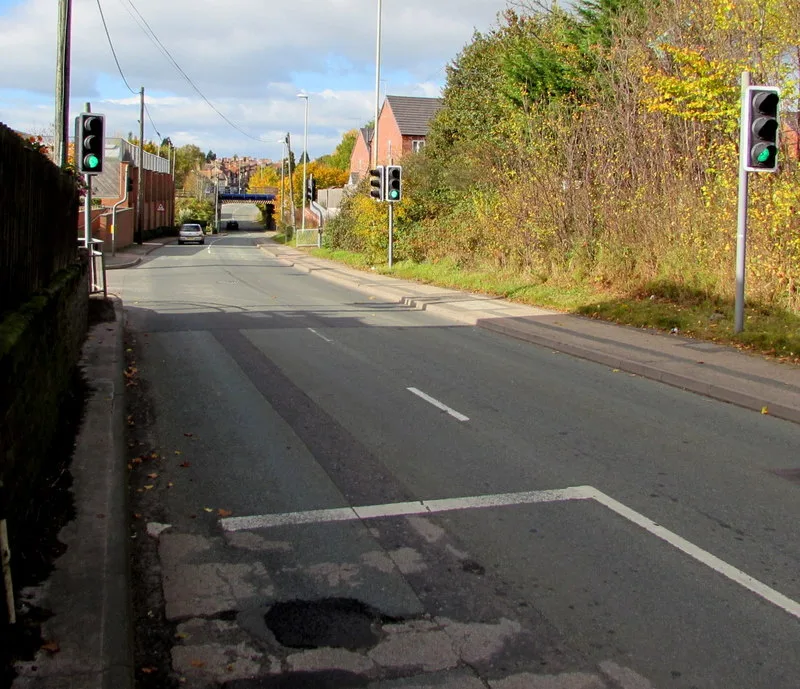
Three Multihog crews plane out potholes on nine Shropshire roads in September, starting Station Road, Shrewsbury on the 1st. All the dates, roads and times.
Shropshire Council’s pothole machines start their September round on Tuesday 1 September on Station Road, Shrewsbury, and there are now three of them.
The council published the September programme on 26 August, adding a third Multihog crew to the two it has been running. Between them the three machines are set to treat nine locations, from Oswestry to Bridgnorth and from Ruyton XI Towns to Wistanstow.
Work is on weekdays only, between 9.30am and 4pm, except where a shorter window is given below.
The September schedule
Multihog 1
- Tuesday 1 September: Station Road, Shrewsbury (9.30am to 2.30pm)
- Thursday 3 September: A442, Radmoor crossroads to A53 Espley roundabout (sections 1 and 2)
- Tuesday 8 September: Roman Road, Wistanstow (9.30am to 2.45pm)
- Monday 14 September: A49 junction at Bayston Hill to the Condover Church Street junction, Shrewsbury (9.30am to 2.45pm)
Multihog 2
- Tuesday 8 September: B4371, the former Bridgnorth district boundary to the Bourton junction at Presthope (section 1), and B4371, Wall Under Heywood Darby Lane to the former South Shropshire district boundary at Easthope (section 2)
- Thursday 24 September: the track to the east of the poultry houses to the Stanwardine Lane junction (section 1) and Blackbow Hill, Ruyton XI Towns (section 2) (9.30am to 2.45pm)
Multihog 3
- Monday 7 September: Chain Lane junction to the start of the Trefonen road, Oswestry (9.30am to 2.45pm)
- Wednesday 9 September: Deepdale Cottages junction with the B4176 to The Walls, Hilton, Bridgnorth
- Monday 14 September: St Martins Road, B5069 junction to B5070 junction, St Martins
What a Multihog actually does
It is not a patching gang with a shovel. The Multevo Multihog planes off the road surface so that a squared-off hole is left for a following gang to fill. The council’s case for it is speed: it avoids having to saw-cut and break out the defective road by hand, and it cuts down on the need for road closures. Each machine can treat 9,000 square metres of road a month.
The number behind the programme
Nine locations in a month is a small dent in a very large network. Shropshire Council maintains 5,166 km of road, which its own highways maintenance transparency report points out is longer than every trunk road and motorway in England put together. Of that, 2,388 km is unclassified: the lanes and estate roads most people actually live on.
That is also the part of the network in the worst state, and the part the council knows least about. In the surveys covering 2020 to 2024, 16% of unclassified roads were rated red, meaning they should be considered for maintenance, with a further 11% amber. The equivalent red figure was 13% for B and C roads and 9% for A roads.
The catch is in the survey dates. Main roads are surveyed every two years and minor roads every four, and the council says its unclassified network has not been surveyed since 2020, with the next survey due by 2026. It does not pretend the 2020 picture still holds. In its own words, “evidence from reactive repairs suggests that this area of the network has deteriorated through recent winters, and we aim to measure the scale of this deterioration as soon as possible”.
Meanwhile the volume of repairs is running flat rather than falling. The council expects to fill 34,000 potholes in 2025/26, against 34,293 in 2024/25 and 39,615 the year before that. Its capital spend on highways is up sharply, from £22.9m in 2024/25 to a projected £35.7m this year, and the share going on preventative work rather than reactive patching has risen from 75.2% to 88.8%.
What it means for you
- If your road is on the list, expect a working day of disruption in the window given, not a full closure. The council’s stated reason for using the Multihogs is that they reduce the need to close roads.
- Check before you travel. The council points drivers to the interactive map on one.network for the detail of each scheme. Our Shropshire roadworks and travel page tracks the bigger closures.
- If your road is not on the list, report the defect. Every pothole is logged during highway safety inspections, with its location and the date it was repaired, and that record is what drives where the money goes.
- A repair is meant to be permanent. The council reports that 99% of defects were repaired permanently in 2024/25, so a hole that reopens within weeks is worth reporting again.
Have your say
We read every message. To comment on this story, email the newsdesk and we may publish a selection of responses: hello@shropshiretoday.co.uk.