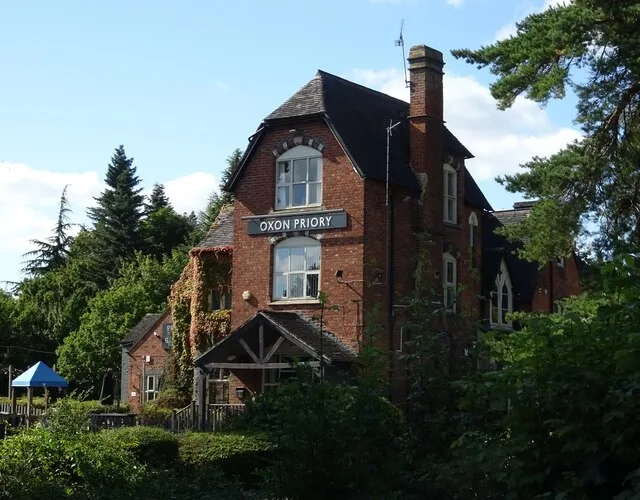

Shropshire Council has approved demolition of the fire-hit Oxon Priory in Shrewsbury. It began as a Victorian vicarage, and no new plan has been lodged.
The fire-damaged Oxon Priory on Welshpool Road in Shrewsbury can now be knocked down. Shropshire Council approved the demolition on 22 September.
The building stands at Shelton Corner, the junction of Welshpool Road and Holyhead Road in Bicton Heath, about two miles north west of the town centre. It closed as a pub and restaurant in July 2025, and a serious fire in October 2025 left parts of it unsafe.
Before it was a pub, it was a vicarage. The planning file shows a clergyman living there by 1870, and that the house kept the same shape for almost a century afterwards.
What the council approved
The decision is a prior approval for demolition, reference 25/04054/DEM. It was made by a planning officer under delegated powers rather than by a committee. The building is not listed and is not in a conservation area, so the council could only rule on how it is demolished and how the site is left afterwards.
The officer report sets out the method:
- the undamaged single-storey parts come down first, then the fire-damaged sections, using a high-reach excavator
- asbestos found in the undamaged sections is removed by a licensed contractor before demolition starts
- exclusion zones are set up around the site, with water spraying to keep dust down
- the building comes down to slab level, and all the rubble is taken away for recycling or disposal
The decision notice gives the owner five years to start. It also warns that if bats are found at any stage, work must stop at once and an ecologist and Natural England must be called in.
No member of the public commented on the application. The council’s ecology team did not object.
Nothing proposed for the site
The demolition approval does not decide what happens next. The officer report says plainly that no restoration, landscaping or redevelopment is proposed as part of this application. Once the building is down, the site is left “in a clean and safe condition”.
The council’s planning register shows no other application for the site. Anything new built there would need its own planning permission, and that application would be open for public comment.
From vicarage to pub
The council’s conservation officer asked for the building to be recorded before it goes, because the original part counts as a non-designated heritage asset: a building of local interest without the protection of a listing.
That record was carried out in December 2025 by Walsingham Planning, for Greene King. Its historic building recording traces the building’s life from the record books and old maps.
The main points from the record:
- 1845: the tithe survey for the parish of St Julian shows no building on the site. Next door stood a toll house on the Shrewsbury to Welshpool turnpike. It was built in the late 1820s as part of Thomas Telford’s improvements to the London to Holyhead road, and in the 1970s it was taken down and rebuilt at the Blists Hill museum.
- 1870: Kelly’s Post Office Directory records the Rev Nathaniel Cooper at the vicarage. By the 1881 census, 14 people lived there: the vicar’s family with seven children, and five servants, including a governess and a nurse.
- 1881: the first Ordnance Survey map of the house marks it as “Vicarage”. Maps from 1900, the 1920s and the 1960s show the main building barely changed.
- 1965: national mapping calls it Oxon House.
- Later 20th century: it becomes a pub called The Cross Roads, after its position on the junction. The extensions and the car park date from then.
- 2004: Greene King acquires it and runs it as a pub restaurant.
The council’s own tree records still carry the old name. Trees on the site, including Scots pines and yews, are protected by the Cross Roads Hotel Tree Preservation Order of 1977.
What survives of the vicarage
The recording describes the original house as Gothic in style, built of red and orange brick with a roof of small clay tiles. Its features include pointed arch windows, decorative coloured brickwork, steep gables, canted bay windows and a tall external chimney stack.
Inside, decades as a pub had already stripped out most of the original layout. The surveyors found parts of the stair hall and staircase, a Gothic arched opening, a second staircase, a four-panel door and an early 20th century style fireplace. Fire and water damage stopped them reaching much of the rest.
The report also says the empty site had been attracting daily antisocial behaviour, despite round-the-clock security. That was one of the reasons given for demolishing it as soon as possible.
What it means for you
- Expect demolition work at Shelton Corner, but no date has been published. The approval allows up to five years to start.
- The pub is not coming back in this building. Anything new on the site needs a fresh planning application, which will appear on the council’s planning register for public comment. Our Shropshire planning news page tracks the bigger applications.
- The history is on file. The conservation officer suggested adding the building record to the Shropshire Historic Environment Record, so the vicarage’s story can outlive the building.
Have your say