
The independent panel says £14,839 is already top quartile. Scrutiny and planning chairs lose £3,710 each, and the automatic annual rise is scrapped.
Shropshire’s 74 councillors were asked this morning to freeze their own basic allowance at £14,839, cut five special responsibility allowances, scrap one altogether and give up the automatic annual rise that has lifted the basic payment by nearly a quarter since 2021.
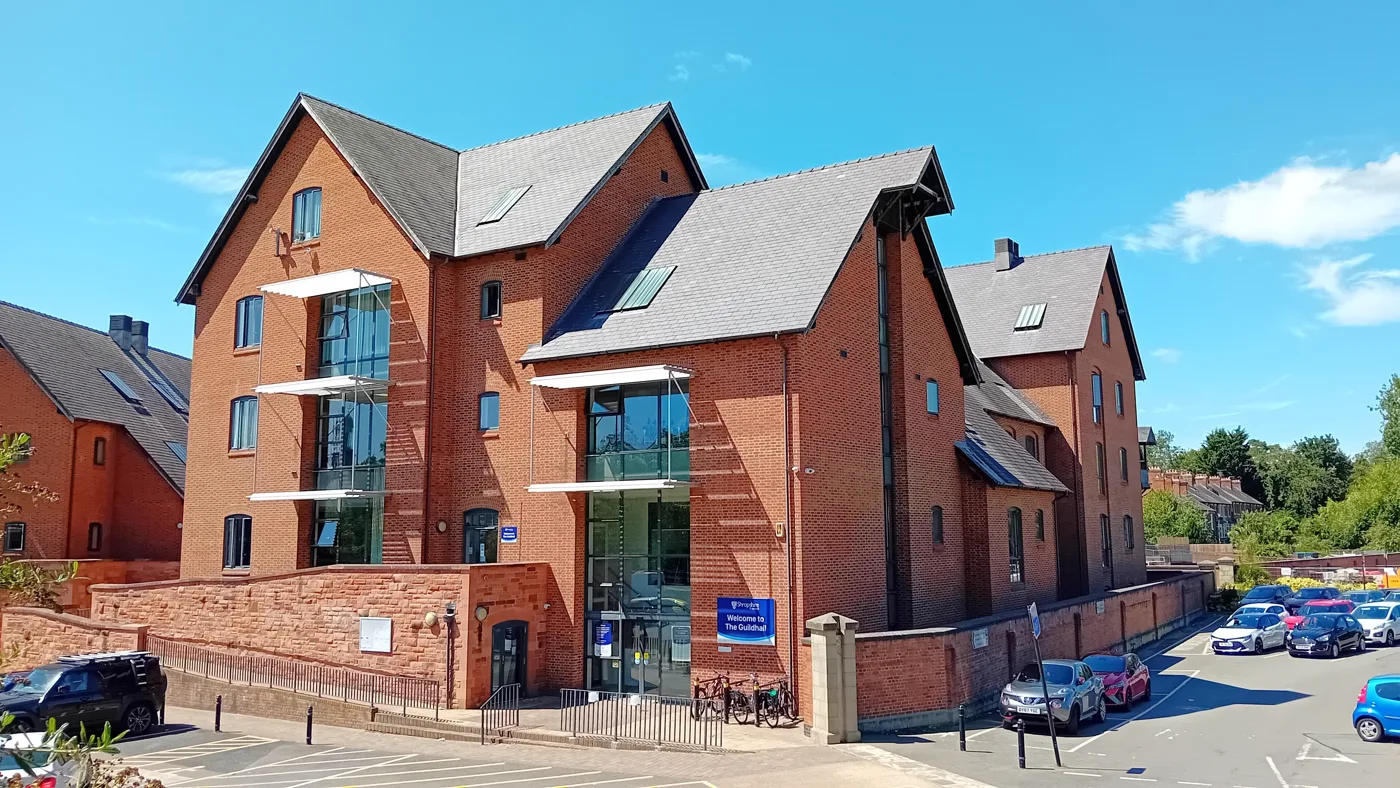
The recommendations come from the council’s Independent Remuneration Panel, which met on 11 June, 6 July and 13 August. Its report went to full Council at the Guildhall in Shrewsbury at 10am on Thursday 24 September. No minutes had been published when this was written, so the vote is not recorded here.
The headline is a freeze, and the panel’s reason for it is one line long:
The allowance is currently in the top quartile of similar, or bigger, unitary councils.
At £14,839 each, the basic allowance across 74 councillors comes to about £1.1m a year before any extra payments. That is our arithmetic, not the council’s; the report puts no total on the scheme.
The automatic rise goes
The change with the longest reach is the one that is easiest to miss.
Since the council last approved allowances in 2021, the basic allowance has been index linked, rising each year in step with the pay award given to local government staff at spinal column point 18. The panel recommends that link is removed, so any future increase has to be proposed and voted on by full Council rather than happening on its own.
The effect of that link is visible in the council’s own constitution. Part 6 of the constitution, last revised on 18 March 2026, still prints the basic allowance as £12,000, the figure set in 2021. The amount actually being paid is £14,839. That is a rise of 23.7% in five years, and it arrived without a vote.
One oddity worth flagging, because it changes how the paragraph reads. The panel’s stated reasoning for removing the link is printed as “The panel does believe this should be ‘automatic’ but voted on by the whole council”, which appears to be missing a word. The recommendation itself is unambiguous: the annual increase is to go.
What goes down, and what goes up
Special responsibility allowances in Shropshire are not set in pounds. They are multipliers of the basic allowance, and the constitution is explicit that “all Special Responsibility Allowances are based on multiples of the Basic Allowance” and that “no member receives more than one”. So a change to a multiplier is a change to a salary, and the pound figures below are those multipliers applied to the £14,839 basic.
| Role | Now | Proposed | Change |
|---|---|---|---|
| Scrutiny committee chairs | 1.0, £14,839 | 0.75, £11,129 | down £3,710 |
| Area planning committee chairs | 0.75, £11,129 | 0.5, £7,420 | down £3,710 |
| Area planning committee vice chairs | 0.25, £3,710 | 0.15, £2,226 | down £1,484 |
| Deputy portfolio holders | 0.25, £3,710 | 0.15, £2,226 | down £1,484 |
| Licensing Sub-Committee chair, also Strategic Licensing vice chair | 0.125, £1,855 | deleted | down £1,855 |
| Audit Committee chair | 0.3, £4,452 | 0.5, £7,420 | up £2,968 |
| Scrutiny committee vice chairs | none | 0.25, £3,710 | new |
| Audit Committee co-opted member | none | 0.1, £1,484 | new |
The panel gives a reason for each. The area planning cuts are because “since the last review some of the work is now carried out by council officials”. The licensing allowance goes because “the meetings are now infrequent”. The scrutiny chair’s cut and the new vice chair’s allowance are described as a rebalancing between the two roles.
The one clear increase is the Audit Committee chair, from 0.3 to 0.5 of the basic allowance. The panel’s reason names the council’s own predicament: “to reflect wider responsibility and Council’s financial situation”.
What is not changing
Every senior allowance stays exactly where it is.
- Leader of the Council, 2.25 times the basic allowance, £33,388
- Deputy Leader, 1.5, £22,259
- Portfolio holders, 1.0, £14,839
- Chairman of the Council, 0.75, £11,129
- Opposition group leaders with at least 10% of the council, 0.5, £7,420
- Strategic Licensing Committee chair and Pensions Committee chair, 0.25, £3,710 each
Those are on top of the basic allowance, so the Leader’s total under the proposed scheme is £48,227 a year.
Three smaller changes with a paper trail behind them
Three further recommendations are administrative, and one of them has a history.
- Mileage would be paid at the HMRC rates in force, rather than a rate fixed in the scheme
- Monthly payments would be worked out as a daily rate multiplied by the number of days in that month, so April pays for 30 days
- Travel and subsistence would not be paid twice. Where a councillor also sits on another authority that has already paid for the same duties, Shropshire would not pay again
The daily-rate change came from the payroll team, which told the panel it “would significantly reduce time spent administering the allowances and provide further safeguards against overpayments in the event of changes in membership or responsibilities”. The report’s risk section is blunter about why that matters: “Internal Audit has previously highlighted member allowance administration as an area requiring ongoing attention.”
The council knew how this would read
The report’s own risk register anticipates the reaction, in both directions.
Its first listed risk is that “changes which are perceived as increasing councillor remuneration may attract adverse public or media attention, particularly given the Council’s financial position”. Its second is the opposite: that allowances too low for the workload risk “discouraging individuals from seeking or undertaking key leadership and governance roles”.
The financial position it refers to is not a small one. Shropshire Council is operating under exceptional financial support from government, and the independent CIPFA review published in August found a £120.7m budget gap and called the council’s finances extremely poor. The external assurance review of that support was item 8 on the same agenda this morning; the allowances report was item 11.
On the cost of the allowances changes themselves, the report says only that they are “not likely to have a material impact on already budgeted amounts for allowances”.
Who the panel heard from
The panel is not made up of councillors. Its report is signed by Timothy Griffiths JP as chairman, with Vince Hunt and Tony Parsons.
It took spoken representations from the Leader, Councillor Heather Kidd, the Deputy Leader, Councillor Alex Wagner, Reform group leader Councillor Dawn Huseman, portfolio holder for transport and regeneration Councillor Rob Wilson, scrutiny committee chairman Councillor Ed Potter and Councillor Teri Trickett. Written representations came from the Liberal Democrat, Conservative and Labour groups, and from Councillors James Owen, Thomas Clayton, Sam Walmsley, Teri Trickett and Sho Abdul.
It also used CIPFA comparison data for other councils, and took account of public sector pay and inflation generally.
What it means for you
Your council tax pays for this, and the freeze holds the bill flat. A frozen basic allowance at £14,839 across 74 councillors keeps the largest part of the scheme at roughly £1.1m a year. Our Shropshire council tax bands page sets out what each band pays.
The removal of the automatic rise is the part to watch over years, not months. It means every future increase has to be proposed in public and voted on by name. The last five years of increases were not.
Full Council is not obliged to accept any of it. The report says the council “is required to have regard to the recommendations of the Panel”, and that it can adopt them, adopt them with amendments, or reject them. Watch for amendments rather than a straight yes or no.
You can read the papers yourself. The agenda and reports for the 24 September meeting are published in full, and the minutes will appear on the same page. Full Council meetings are open to the public at the Guildhall, Frankwell Quay.
Update, 24 September 2026: this article was published while the meeting was sitting. We will add the outcome, and note any amendment, when the council publishes it.
Sources
- Shropshire Council, Council agenda, Thursday 24 September 2026, 10.00am, items 8 and 11
- Members Allowances 2026, report to Full Council, and Appendix 1, Report of the Independent Remuneration Panel
- Part 6 of the Shropshire Council constitution, Members’ Allowances Scheme, revised 18 March 2026
- Shropshire Council newsroom, Councillor allowances set to be frozen or cut, 18 September 2026
- Councillor count taken from the council’s own member index, read 24 September 2026
Have your say