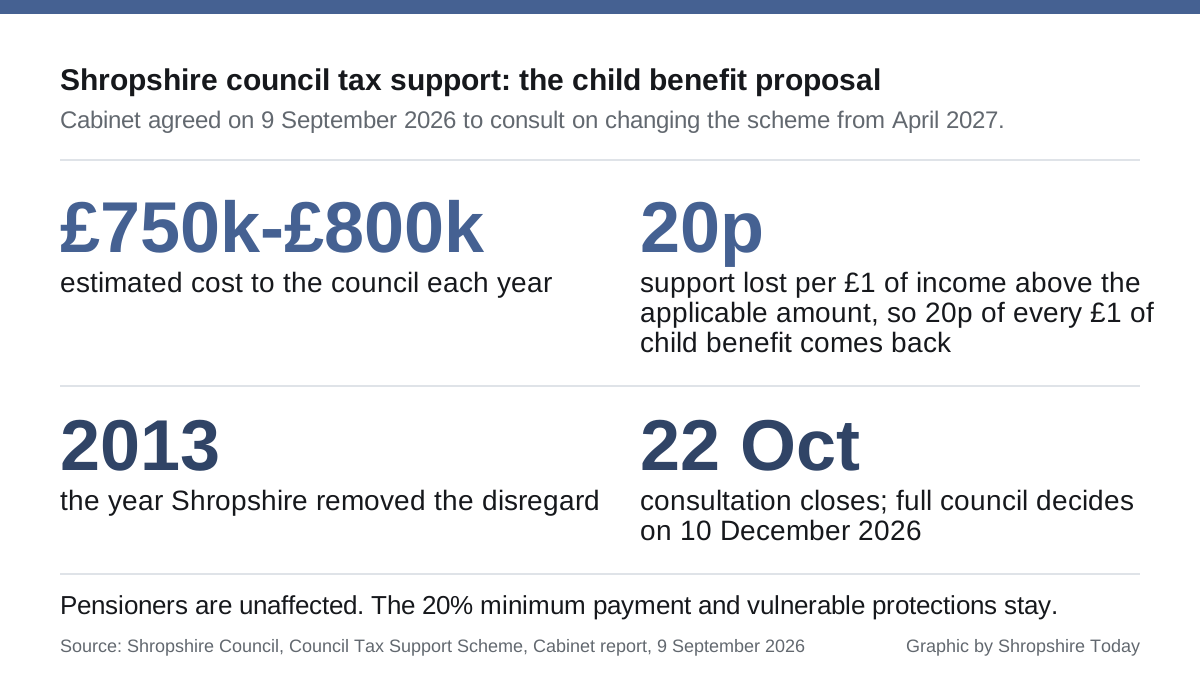

Families with children would pay less council tax from April 2027 if child benefit stops counting as income. The consultation closes on 22 October.
Shropshire Council wants to stop counting child benefit as income when it works out how much council tax support a household gets. If it goes through, low income families with children will pay less council tax from April 2027.
The council took the opposite decision in 2013 and has kept it for thirteen years. Its own Cabinet report now calls that “a deeply unpopular change” which “impacted on many claimants”.
A six week public consultation opened on 10 September and closes on 22 October. Cabinet will look at the responses on 18 November. Full council takes the final decision on 10 December.
What is actually being proposed
Council tax support is a discount on your council tax bill, not a cash payment. Shropshire runs a tapered scheme. The council works out a figure for the minimum you need to live on, called the applicable amount. For every £1 of income you have above it, your support falls by 20p.
Child benefit currently counts as part of that income. The proposal is to leave it out of the sum altogether.
The Cabinet report of 9 September sets out the package Cabinet agreed to consult on:
- disregard child benefit as income, at an estimated cost of £750,000 to £800,000 a year
- keep the tapered scheme rather than move to a banded one
- keep the 20% minimum payment every working age claimant makes
- keep the existing protections for vulnerable claimants
- keep topping up the minimum payment from the Crisis Resilience Fund, at up to £90 in 2027-28 and up to £100 in 2028-29
Pensioners are not affected either way. Their support is still worked out under the old national council tax benefit rules.
What it is worth to a family
The council has not published a figure for what an individual household would gain, so here is the arithmetic from its own description of the scheme.
Child benefit is currently £27.05 a week for the eldest or only child and £17.90 for each other child. On a 20p taper, taking that out of the income calculation raises support by:
- about £5.41 a week, or £281 a year, for a family with one child
- about £8.99 a week, or £467 a year, for a family with two children
- about £12.57 a week, or £654 a year, for a family with three children
Two caveats matter. This only applies to households on the taper, meaning those whose income is above their applicable amount. And support cannot exceed 80% of the bill, because of the minimum payment, so a household already at that ceiling gains nothing.
For scale, a band D home in a Shropshire parish that charges no precept pays £2,400.03 this year. Our council tax bands page has the figure for all 164 parish areas.
Why universal credit made this worse
The report is specific about who has been hit hardest, at paragraph 5.10.
Before universal credit, people on income support, income based jobseeker’s allowance or income based employment and support allowance were “passported”. That meant they automatically got the maximum support, 80%, or 100% if they were classed as vulnerable. No income calculation was done.
Those benefits are being replaced by universal credit, and universal credit is not passported. So the same household is now assessed on its actual income, child benefit included. The report says this “has seen some claimants worse off when transitioning to Universal Credit”. The child benefit disregard is the council’s answer to that.
Shropshire asks more of claimants than Telford does
The report includes the council’s own comparison with neighbouring authorities. It is not flattering.
| Authority | Scheme | Capital limit | Minimum payment | Band cap |
|---|---|---|---|---|
| Shropshire | Tapered | £10,000 | 20% | No |
| Telford and Wrekin | Banded | £6,000 | 10% | No |
| Herefordshire | Tapered | £6,000 | None | No |
| Cheshire West | Tapered | £6,000 | 25% | Band D |
| Cheshire East | Banded | £6,000 | 20% | Band D |
| South Staffordshire | Tapered | £16,000 | 20% | Band D |
| Wyre Forest | Banded | £6,000 | 10% | No |
| Sandwell and Dudley | Tapered | £3,000 | 15% | Band B |
| Southwark | Tapered | £16,000 | 15% | No |
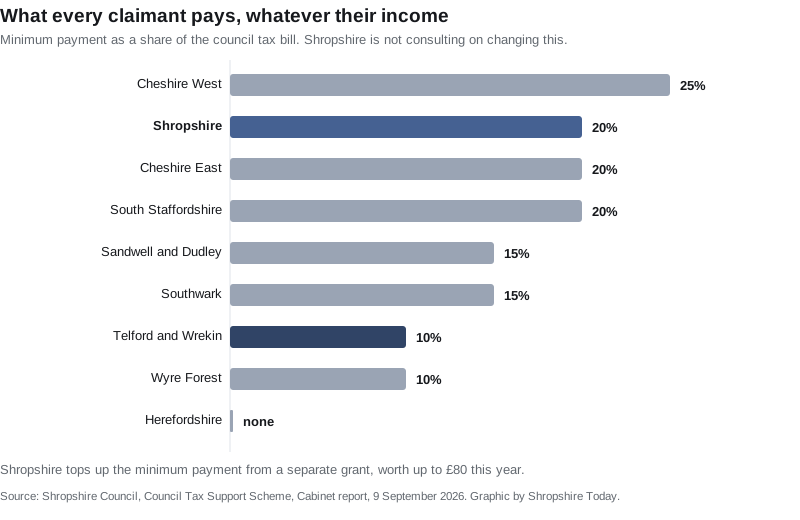
Shropshire lets a claimant hold £10,000 in savings, against £6,000 at Telford and Wrekin and Herefordshire, though South Staffordshire allows £16,000. On the minimum payment it goes the other way. Shropshire asks working age claimants for twice what Telford and Wrekin asks, and Herefordshire asks for nothing at all. None of that is up for change in this consultation.
The council looked at a banded scheme and rejected it
Several councils have moved to banded schemes, which set a fixed percentage discount by income band. Shropshire considered it and said no, for a reason worth reading if you have ever turned down extra hours.
Banded schemes create cliff edges. The report’s own worked example uses a single person: on £99 a week they would pay 20% of their bill, on £101 a week they would pay 40%. Two pounds a week of extra income doubles the share of the bill they have to find.
The report also says a banded scheme would need specialist design help, changes to the underlying IT system and retraining, at a time of “continued strains on the Council Tax team as it attempts to rebuild capacity”.
Where the £800,000 comes from
The council is not pretending this is free. Cabinet member for finance Roger Evans, quoted in the council’s announcement, put it plainly: “By proposing to disregard Child Benefit, we know that we will lose some Council Tax income. However, this is the morally correct decision.”
The cost has to be written into the medium term financial plan, which Cabinet next reviews in November. That is the same council which was given exceptional government permission to raise council tax by 8.99% this year, four percentage points above the referendum cap, after declaring a financial emergency.
The minimum payment has also been softened by grants every year since 2020, though the amount has shrunk:
| Billing year | Source | Up to |
|---|---|---|
| 2020-21 | Covid grant | £200 |
| 2021-22 | Covid grant | £200 |
| 2022-23 | Covid grant | £50 |
| 2023-24 | Cost of living grant | £60 |
| 2024-25 | Household Support Fund | £60 |
| 2025-26 | Household Support Fund | £60 |
| 2026-27 | Crisis Resilience Fund | £80 |
The proposal would lift that to up to £90 in 2027-28 and up to £100 in 2028-29.
What it means for you
If you claim council tax support and you get child benefit, this is the change to watch. Nothing happens to your bill before April 2027, and nothing is settled until 10 December.
If you have children, are on a low income and do not claim council tax support, it is worth checking whether you should. The scheme covers working age households with capital under £10,000. Applications go through Shropshire Council’s benefits service.
If you want to respond to the consultation, you have until 22 October:
- the survey on the council’s consultation portal
- by email to TellUs@shropshire.gov.uk
- by post to Feedback and Insight Team, Shropshire Council, PO Box 4826, Shrewsbury, SY1 9LJ
- by phone on 0345 678 9000 if you need the survey in another format
Town and parish councils, housing associations, the police and fire authorities and voluntary sector advice groups are all being written to directly, because every one of them is affected by what the council does with its tax base.
Key dates
- 10 September 2026 consultation opened
- 22 October 2026 consultation closes
- 18 November 2026 Cabinet reviews the responses
- 10 December 2026 full council decides
- 1 April 2027 any change takes effect
Sources
- Shropshire Council, Council Tax Support Scheme, Cabinet report, 9 September 2026
- Shropshire Council, Cabinet agenda and papers, 9 September 2026
- Shropshire Council, Council Tax Support Scheme 2027 onwards consultation
- Shropshire Council newsroom, Residents to have their say on Council Tax Support proposals, 11 September 2026
- GOV.UK, Child Benefit rates
Have your say